

Chief Economists Outlook
January 2025

Disclaimer
This document is published by the World Economic Forum as a contribution to
a project, insight area or interaction. The findings, interpretations and conclusions
expressed herein are a result of a collaborative process facilitated and endorsed
by the World Economic Forum but whose results do not necessarily represent the
views of the World Economic Forum, nor the entirety of its Members, Partners or
other stakeholders.
© 2025 World Economic Forum. All rights reserved. No part of this publication may
be reproduced or transmitted in any form or by any means, including photocopying
and recording, or by any information storage and retrieval system
Chief Economists Outlook
January 2025
This briefing builds on the latest policy
development research as well as consultations
and surveys with leading chief economists
from both the public and private sectors,
organized by the World Economic Forum’s
Centre for the New Economy and Society.
It aims to summarize the emerging contours of
the current economic environment and identify
priorities for further action by policy-makers
and business leaders in response to the
compounding shocks to the global economy
from geoeconomic and geopolitical events.
The survey featured in this briefing
was conducted in late November 2024.
Content
Executive summary_ ______________________________________________ 5
- Downside risks have risen ______________________________________ 7
- All eyes on the US ____________________________________________ 14
- Global integration under growing strain _________________________ 18
Domestic and international policy drivers_ _________________________ 18
The challenges of fragmentation _________________________________ 20 - A turbulent year for trade _____________________________________ 23
Trade-war dynamics set to intensify ______________________________ 23
The shift to services trade continues _____________________________ 25
References _____________________________________________________ 28
Contributors _ ___________________________________________________ 33
Acknowledgements_ _____________________________________________ 34
Executive summary
The January 2025 edition of the Chief
Economists Outlook launches at the
start of what is likely to be an eventful
year for the global economy. The outlook
remains subdued, with a majority of chief
economists (56%) expecting the global
economy to weaken over the next year,
compared to 17% anticipating improvement.
Expectations for global growth are muted
overall but subject to significant regional
divergence. The US economy is expected
to deliver robust growth in 2025, and South
Asia, particularly India, is also expected
to maintain strong growth. The outlook
for Europe remains gloomy, with 74%
of respondents predicting weak or very
weak growth this year. The outlook for China
also remains weak, and growth is projected
to slow gradually in the years ahead.
Global inflation is easing, with the
International Monetary Fund (IMF) projecting
an annual average of 4.3% in 2025, down
from 5.8% in 2024. However, services
inflation remains higher than goods inflation,
particularly in advanced and emergingmarket
economies. Moderate inflation is
expected in most regions, but the uptick
in the short-term outlook for growth in the
US has been accompanied by a significant
increase in inflation expectations, according
to the chief economists.
The chief economists expect US policy
to have a significant impact on the
global economy in the years ahead.
A majority (61%) characterize this impact
as a long-term shift rather than a shortterm
disruption. Under the incoming
administration, the chief economists expect
significant changes across trade, migration,
deregulation, fiscal policy, industrial policy
and foreign policy. Large majorities expect
to see increases in inflation and public debt
levels, as well as stock-market gains.
The global economic landscape is
increasingly fragmented. This is particularly
true for goods trade, where 94% of chief
economists expect further fragmentation
over the next three years. Significant
majorities also expect increased barriers
to labour mobility and transfers of
technology and data. Geopolitical rivalries
and domestic policy choices are viewed
as the key drivers of current fragmentation
trends, highlighting the growing importance
of interactions between political and
economic factors.
The main impact of rising fragmentation
that the chief economists highlight is a
likely increase in costs for consumers
and businesses. Collaboration on global
challenges such as climate change is
also expected to become more difficult.
In response to these shifts in the global
landscape, the chief economists expect
multinational companies to respond with
a range of adaptations, including changes
to supply chains and organizational
restructurings.
The chief economists expect an intensification
of trade-war dynamics in the years ahead,
both between the US and China and more
broadly. However, the expectation is also
that trade volumes will continue to increase.
There is consensus that protectionism will
cause durable changes to trade patterns
over the next three years, with conflict and
national security concerns also highlighted
as important drivers of change.
The chief economists expect growing
regionalization of trade, as well as a
continuation of a gradual shift in the
composition of trade from goods to
services. In general, advanced economies
tend to benefit more than developing
economies from services trade, but a
majority of the chief economists point to the
increasing importance of services as a driver
of economic development.
- Downside risks
have risen
The outlook for the global economy remains
subdued and downside risks have intensified,
not least because of heightened uncertainty
around the economic implications of
November’s US presidential election.
According to the World Economic Forum’s
latest survey of chief economists, a majority
(56%) expect the global economy to
weaken over the next year compared
to 17% who expect it to strengthen (see
Figure 1). Compared to the last survey
in August 2024, expectations for the year
ahead have softened.1
Figure 1. The global economic outlook
Looking at the year ahead, what are your expectations for the future condition
of the global economy?

At the time of writing, the International
Monetary Fund’s (IMF) latest projection
is that the global economy will expand
by 3.2% this year, unchanged from 2024,
and that it will slow marginally to 3.1%
over the next five years.2 This remains one
of the weakest medium-term outlooks in
decades, and there are signs elsewhere of
global forecasts being trimmed to reflect the
impact of expected changes to US policy.3
The next section will look at the outlook
for the US economy in greater detail,
but expectations of a short-term boost
are reflected in 44% of chief economists
pointing to strong US growth in 2025 (see
Figure 2) – three times as many as in the
last survey.4 The chief economists expect
developments in the US to exert a drag on
global growth, but they continue to expect
significant divergence across regions.
1 World Economic Forum. (2024).
2 International Monetary Fund (IMF). (2024a).
3 Morgan Stanley. (2024).
4 Goldman Sachs. (2024).
South Asia continues to stand out, with
61% of chief economists expecting strong
or very strong growth in 2025. This regional
performance has been driven largely by
robust growth in India, which remains the
world’s fastest-growing major economy.
However, there are now signs of some
momentum being lost: the latest national
accounts data for India point to year-onyear
GDP (gross domestic product) growth
of 5.4% in the third quarter of 2024, the
slowest rate in nearly two years, prompting
a downward revision to the central bank’s
annual growth forecast in December.5
Elsewhere in the region, there has been strong
growth in the countries of ASEAN (Association
of Southeast Asian Nations), where GDP
is expected to expand by 4.7% in 2025.6
Figure 2. Growth expectations
What is your expectation for economic growth in the following geographies in 2025?

5 Kaushik & Reed. (2024).
6 International Monetary Fund (IMF). (2024b).
For almost three years, Europe has registered
the weakest regional prospects among chief
economists, and in the latest survey, 74%
of respondents expect weak or very weak
growth for the region. The challenges facing
the region were highlighted in the most
recent national accounts data for the Euro
area, which recorded aggregate year-onyear
growth of just 0.9% in the third quarter
of last year – this compares to 2.7% in the
US over the same period.7 The Euro area’s
largest economy, Germany, contracted by
0.3%, while there was growth of 0.4% in
Italy, 1.2% in France and 3.4% in Spain.8
In a September report, Mario Draghi, the
former Italian prime minister and governor
of the European Central Bank, spotlighted
Europe’s economic challenges. Sounding an
alarm for the region’s economic prospects,
his report warned that annual investment
equivalent to 5% of GDP would be required
to revive its economic dynamism.9 However,
the prospects of determined action to boost
the European economy looked distant at the
end of 2024, with both Germany and France
mired in domestic political difficulties.
The outlook for China also remains weak.
Growth is expected to slow gradually and
is projected by the IMF at 4.8% in 2024 and
4.5% in 2025.10 Earlier forecasts for 2024
were revised downwards from 5% as a
result of disappointing domestic demand
in the second quarter, and high-frequency
data suggest that while exports have picked
up, consumer demand has remained
subdued.11 November retail sales growth
of 3% missed expectations of 4.6%.12
Over the medium term, growth is projected
to slow down to about 3.3% in 2029 amid
headwinds from weak productivity and
an ageing population.13
In the other regions covered in the survey,
the assessments of the chief economists
surveyed remain broadly unchanged from
the previous survey. For the Middle East
and North Africa, almost two-thirds expect
moderate growth in the year ahead, but
the risks to this outlook are highlighted
by the fact that more than twice as many
respondents expect weak growth rather
than strong. For Sub-Saharan Africa, the
share of chief economists who expect
moderate or stronger growth in 2025
increased to 78%. This uptick is in line
with the projection of solid 4.2% growth
for the region this year from the IMF.14 For
Latin America and the Caribbean, almost
two-thirds of chief economists continue
to expect moderate growth this year.
7 Eurostat. (2024).
8 Ibid.
9 Draghi, M. (2024).
10 International Monetary Fund (IMF). (2024b).
11 Ibid.
12 Hale et al. (2024).
13 International Monetary Fund (IMF) Asia and Pacific Department. (2024).
14 International Monetary Fund (IMF). (2024a).
Global inflation continues to ease, with the
IMF projecting an annual average of 4.3%
this year, down from 6.7% in 2023 and
an estimated 5.8% in 2024.15 This overall
deceleration has been driven primarily
by the advanced economies, which have
been returning to their inflation targets
more rapidly than emerging-market and
developing economies. Services inflation
has been slower to ease than goods
inflation, and in numerous advanced and
emerging-market economies, the core
services inflation rate is still around 50%
higher than before the pandemic.16
Regional inflation assessments by chief
economists (see Figure 3) show that, after
November’s election, the US now leads
in inflation expectations. However, nearly
three-quarters of respondents still anticipate
only moderate inflation in 2025. Most of the
regions record a broadly similar pattern, with
a significant majority expecting moderate
inflation and a much smaller share expecting
either weak or strong inflation.
Figure 3. Inflation expectations
What is your expectation for inflation in the following geographies in 2025?

15 International Monetary Fund (IMF). (2024a).
16 Ibid.
In Latin America and the Caribbean, the
share of respondents expecting low inflation
increased from just 6% in the last survey
to 21% in the latest. Europe and the East
Asia and Pacific region have notably higher
proportions of respondents anticipating
low inflation (36% and 41%, respectively).
However, China is the unsurprising outlier
given the deflationary pressures the country
has been grappling with. Interestingly,
the chief economists’ assessment (80%
expecting low or very low inflation) is more
bearish than in the last survey (69%).
This contrasts with the view of the IMF in its
latest “Article IV” assessment of the Chinese
economy, which estimates that consumer
price inflation will pick up from 0.7% last
year to 1.9% this year.17
Figure 4. Monetary policy outlook
What is your expectation for monetary policy in the following geographies in 2025?

17 International Monetary Fund (IMF) Asia and Pacific Department. (2024).
While central banks remain vigilant following
the inflationary surge of recent years, the
tightening phase for global monetary policy
has clearly ended. The overwhelming
majority of chief economists expect policy
to remain unchanged or loosen in all regions
this year, with expectations of interest rate
cuts highest for Europe, China and the US.
Given the large discrepancies in the
economic prospects for Europe and the US,
the policy stances of the European Central
Bank (ECB) and the Federal Reserve are
expected to diverge further.18 With growth
in the Euro area projected to remain low and
inflation expected to settle around the target
rate of 2%, the ECB looks likely to continue
on a path of further interest rate cuts,
following three cuts of 0.25% in the final
four months of 2024, which took the main
policy rate to 3%.19 In the US, the Federal
Reserve cut rates by a full percentage point
during the same period (to 4.5%), but its
outlook has shifted, and in December, it
signalled a slower pace of loosening in
2025 than previously expected.20 This pivot
to a more hawkish position jolted financial
markets – the dollar jumped to a two-year
high, and the S&P500 stock index dropped
by nearly 3%.21
Figure 5. Fiscal policy outlook
What is your expectation for fiscal policy in the following geographies in 2025?

18 Giles, C. (2024).
19 European Central Bank (ECB). (2024).
20 Clarfelt, H. & Smith, C. (2024).
21 Ibid.
In terms of fiscal policy, large majorities
of the chief economists surveyed expect
a looser stance in the US and China this
year (75% and 90%, respectively), while
views on Europe are split but with a slight
skew towards tightening. Elsewhere, most
respondents expect fiscal policy to remain
unchanged in the year ahead. However, the
backdrop for fiscal policy decisions is likely
to continue to pose significant challenges.
The latest IMF estimate for global public
debt in 2024 is more than $100 trillion, with
the potential to reach 115% of GDP over the
next three years.22 Moreover, governments
will face mounting pressures to address
a “fiscal policy trilemma”23 of dealing with
the costs related to security, population
ageing and climate change, without either
jeopardizing debt sustainability or leading
to political pushback against rising taxes.24
22 International Monetary Fund (IMF). (2024c).
23 Gaspar, V. (2024).
24 International Monetary Fund (IMF). (2024c).
2.All eyes on the US
This edition of the Chief Economists Outlook
launches as a new US administration
takes office. The systemic importance of
the US to the global economy means that
changes of administration are always closely
assessed for their potential domestic and
international implications. However, this
pattern has been unusually intense since
November’s election, both because of
already-fraught global conditions and the
platform of dramatic policy change on which
the President campaigned.25
Among the chief economists surveyed,
there is unanimity that developments in
the US will alter the trajectory of the global
economy, with a solid majority of 61%
characterizing this change as a long-term
shift rather than a short-term disruption
(see Figure 6). This echoes the view that
whereas the first Trump administration could
be seen by some as a blip, the second
should be seen more as an inflection
point for the political and economic
order, consolidating trends that have been
gathering momentum in many countries
since the global financial crisis.26
The chief economists’ expectations for
policy change in the US are broadly in line
with the policy priorities articulated during
the election campaign, with large majorities
expecting significant change in the areas
of trade, migration, deregulation, fiscal
policy, industrial policy and foreign policy.
The only policy area in which respondents
do not expect significant change is
monetary policy, where the Federal
Reserve is legally independent of both
the presidency and Congress. However,
monetary policy may have a significant role
to play in cushioning developments in the
real economy if changes in other policy
areas prove to be inflationary.27
Figure 6. Global impact
How would you characterise the likely impact of the US election result on the trajectory
of the global economy?

25 The American Presidency Project. (2024).
26 Klein, E. (2024).
27 United States Federal Reserve. (2024
Figure 7. Policy outlook
In which US policy areas do you expect to see the most significant changes under
the new US administration?

If fully implemented, the new administration’s
campaign agenda would be a significant
departure from current economic policy.28
However, there remains a high degree of
uncertainty over the extent to which the
campaign agenda will be implemented. For
example, while 68% of the chief economists
expect very significant changes to trade
policy, more than 90% expect that new US
tariffs will be smaller than the ones promised
during the presidential campaign (see
Figure 15).29 Caution is needed, therefore, in
anticipating the likely magnitude of changes
in 2025 and beyond.
One potential restraining influence on
policy could be consumer prices, which
were a central issue during the presidential
campaign. The evidence suggests that
many voters were less concerned with
the decelerating rate of change of prices
(consumer price inflation had fallen to
2.7% in November 202430) than with their
cumulative increase (around 20% over the
four preceding years).31 It is therefore at
least possible that the new administration
will not want to risk being associated
with a renewed period of rising prices.
Nevertheless, among the chief economists,
94% expect the inflation rate to increase
under the new administration (see Figure 8),
with the proportion expecting high inflation
in 2025 doubling since the last survey
(see Figure 3).
28 The Economist. (2024a).
29 In February 2024, Donald Trump announced that he would increase tariffs on all goods from China by 60% and introduce
new tariffs of 10% across the board (Piciotto, 2024). In November 2024, he clarified that he would introduce 25% tariffs
on goods from Mexico and Canada and an additional 10% on all Chinese goods coming into the US (Pitas, 2024).
30 U.S. Bureau of Labor Statistics. (2024).
31 Goudreau, C. (2024).
Figure 8. Economic impact
What changes do you expect to the following US economic and financial indicators under
the new US administration?

This is in line with a strong consensus
that the new administration’s campaign
platform would be highly inflationary.
Key elements that could be expected to
drive prices higher include the stimulus
effect of lower taxes (expected by 91%
of chief economists) and the impact on
wages and prices of the labour supply
shock that would result from a maximal
implementation of a promised programme
of mass deportations.32 Potential tariff
increases would add even more pressure
(see section 4). It is notable that inflation
expectations in the US ticked up in the
weeks following the election.33
The chief economists are near-unanimous
(97%) in their expectation that public
debt levels will rise, pointing to a lack of
confidence that tax cuts will be matched
by a promised drive to cut public spending,
which is being spearheaded by a new highprofile
advisory commission (the Department
of Government Efficiency).34
32 Rogers, T. N. (2024).
33 World Bank. (2024a).
34 The Economist. (2024b
A majority (56%) also expects the
unemployment rate to remain unchanged,
while almost two-thirds (62%) expect
wage levels to rise. A large majority of
respondents (80%) anticipate stock market
gains, in line with widespread expectations
of a business-friendly stance in areas such
as taxes and deregulation.
On expectations for growth, the chief
economists differentiate between likely
trends in the US and internationally (see
Figure 9). Domestically, almost half (47%)
expect a positive or somewhat positive
short-term impact on growth from the
new administration’s policy agenda, but
this figure falls away in the medium term
(27%), and over the long term, more than
half of respondents (53%) expect the
impact of policy to be somewhat negative
or negative on growth. Globally, the position
is more unambiguously gloomy, with
large majorities expecting a negative or
somewhat negative impact on growth over
the short term (68%), medium term (80%)
and long term (65%).
Figure 9. Growth impact
What will be the impact of the next US administration’s policy agenda on growth…
…in the US?

- Global integration
under growing strain
Domestic and international
policy drivers
The global economic landscape continues to
fragment, with multiple forces increasing strain
on different dimensions of global economic
interconnectedness (see Figure 10). This is
perhaps most clearly evident in relation to the
global trading system, where an intensification
of trade-war dynamics is a significant
possibility in 2025. There is near-unanimity
(94%) among the chief economists surveyed
that there will be further fragmentation of
goods trade over the next three years, while
a smaller majority (59%) expects the same
for services trade. The outlook for global
trade is covered in more detail in section 4.
After goods trade, labour mobility is the
next area where fragmentation is most
likely, with more than three-quarters
of chief economists expecting higher or
much higher levels of fragmentation. This
expectation occurs against a backdrop
where growing political pushback against
immigration is coupled with record volumes
of immigration. Data released in late 2024
show that legal migration to the 38 member
countries of the Organisation for Economic
Co-operation and Development (OECD)
totalled 6.5 million in 2023, a 10% increase
on the previous record in 2022.35 This trend
appears to have played a significant role in
the global pattern of anti-incumbent voting
in the many national elections that took
place in 2024, and one analyst suggests
that a new “misery index” combining
inflation and immigration shows the highest
level of socioeconomic upheaval that many
countries have seen in generations.36
Almost two-thirds of the chief economists
surveyed expect higher fragmentation
around transfers of technology and data.
National security is playing an increasingly
important role in constraining global flows
of knowledge and technology, in addition
to concerns around data privacy and
intellectual property protection.37 Moreover,
deepening fragmentation in high-technology
sectors threatens to have an outsized
economic impact, given that in most
countries, these sectors tend to be highgrowth
and highly trade-intensive.38
35 Borrett, A. & Strauss, D. (2024).
36 Burn-Murdoch, J. (2024).
37 Cerdeiro, D. et al. (2023).
38 Ibid.
Figure 10. Fragmentation outlook
What is your expectation for the integration or fragmentation of the global economy
in the next three years in the following areas?
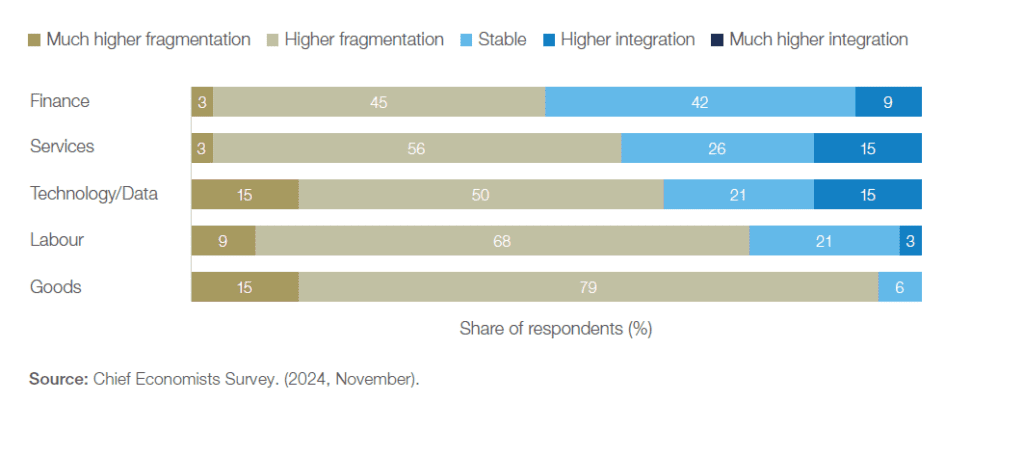
The financial sector is something of an
outlier, with less than half (48%) expecting
increased fragmentation over the next
three years. This is likely to reflect the
pivotal role of cross-border financial flows
in the functioning of modern economies
and the level of disruption that would
follow any significant fragmentation of the
system. This situation is not without risks,
however, given current levels of political
volatility. The evidence of recent years
suggests that there is a growing appetite
among some to break established norms
and patterns, even if this entails significant
disruption.39 Moreover, it should be noted
that finance is by no means immune
from fragmentation trends: for example,
geopolitical tensions already have a marked
impact on foreign direct investment (FDI)40
and portfolio investment flows.41
When the chief economists were asked
about the factors contributing to current
levels of fragmentation, domestic and
international political drivers stand out
(see Figure 11).
More than 90% of respondents view
geopolitical rivalries as an important factor,
with two-thirds viewing them as very
important. The strategic rivalry between the
US and China is at the heart of this, but there
is mounting evidence of wider disruptions in
the geopolitical landscape. According to one
measure published last year, geopolitical and
geoeconomic fragmentation has risen sharply
since the global financial crisis, peaking
during the COVID-19 pandemic.42 However,
recent events, particularly in Ukraine and
across the Middle East, suggest that the
trend of widening and intensifying geopolitical
instability may still have some way to go.
39 Williams, A. (2024).
40 Boeckelman, L. et al. (2024).
41 Catalan, M. et al. (2024).
42 Fernández-Villaverde, J. et al. (2024).
Figure 11. Drivers of fragmentation
To what extent do you think the following factors are important contributors
to current levels of global economic fragmentation?

Domestic policy choices were cited
by almost all respondents (97%) as an
important contributor to global economic
fragmentation and by around one-third
as very important. Whereas geopolitical
rivalries may lead to a mix of intended and
unintended fragmentation of the global
economy, the role of domestic policy
choices highlights the growing electoral
constituency in many countries that
supports a rolling back of at least some
aspects of global integration. In particular,
as noted above, immigration has become
an increasingly central political issue in
many countries.
The challenges of fragmentation
While these developments may have large
distributional impacts, the chief economists
see no clear economic gains in the
aggregate. Framing the question in terms
of economics perhaps misses the political
gains that proponents of reduced global
economic integration often hope to achieve,
but it is nevertheless striking how little
economic upside is expected overall.
When asked whether fragmentation could
lead to a reduction in systemic economic
and financial risks – for example, by
reducing the potential for cross-border
contagion effects during a crisis – 88%
of chief economists viewed this as unlikely
or very unlikely over the next three years
(see Figure 12). When asked whether there
might be reduced within-country inequality –
for example, because of greater policy
autonomy or strengthened bargaining power
for workers – 79% viewed it as unlikely
or very unlikely. Although the results are
more mixed, the chief economists are also
unconvinced that fragmentation will lead
to a surge in innovation as a by-product
of technological competition between
geopolitical rivals. Only 21% of respondents
view this as likely or very likely, while 36%
view it as unlikely or very unlikely.
Figure 12. Impacts of fragmentation
In light of current trends, how likely is it that over the next three years global
fragmentation will lead to…

The clearest expectation of the chief
economists surveyed is that global
fragmentation will lead to higher prices,
with unanimous agreement that it is likely
or very likely that costs for consumers
and businesses will increase over the next
three years. One potential channel for such
inflationary pressure is the disruption of
global value chains – for example, through
companies’ increasing use of reshoring
and friend-shoring.43 A 2024 survey of US
chief executive officers (CEOs) and chief
operating officers (COOs) showed that
the proportion of companies with plans
to shorten their supply chains had jumped
to 81% from 63% in 2022,44 while in 2023,
an annual index of reshoring in the US
registered its largest increase on record.45
Moreover, in the US and elsewhere, the
process of reshoring is being bolstered
by governments’ adoption of interventionist
industrial policies, a trend that almost all
(97%) chief economists expect to accelerate
as a result of global fragmentation.
43 Nagel, J. (2024).
44 Bain & Company. (2024).
45 Kearney. (2024).
The survey responses point to an
increasingly complicated and strained global
landscape over the next three years: a
more bipolar system (79%), with a widening
divide between the Global North and South
(64%), declining levels of FDI (73%) and
a shift towards regional cooperation (58%).
The prospects for global collaboration are
diminishing, especially for climate change
(81%), while the proportion of respondents
expecting the risk of conflict to increase
is worryingly high (88%).
Increasing global economic fragmentation
poses a particular strategic challenge for
multinational companies operating across
geopolitical and geoeconomic fault lines.
Only around one in 10 chief economists
expect these companies to adopt a waitand-
see approach to increasing levels of
fragmentation. By contrast, over three-quarters
expect them to embark on potentially costly
changes such as restructuring their supply
chains (91%), regionalizing their operations
(90%), focusing on activity in core markets
(79%) or exiting high-risk markets (76%).
There is already evidence of significant
structural changes taking place. For
example, in October 2024, a major global
lender announced a restructuring of its
operations into “eastern” and “western”
groupings.46 Although the stated rationale of
the move was to reduce costs and increase
agility, it was widely perceived as being
partly motivated by geopolitical de-risking.47
Figure 13. Business response to fragmentation
How do you expect multinational companies to respond over the next three years
to global economic fragmentation?

46 Aliaj, O. et al. (2024).
47 Davies, P. J. (2024).
4.A turbulent year for trade
Trade-war dynamics set to intensify
Among all the indications of the economic
fragmentation discussed in the previous
section, the erosion of support for the
global trading system is the most prominent.
Although global trade is on track to hit
a record $33 trillion in 2024,48 the system
is facing significant threats. Institutionally,
this is evident in the unresolved breakdown
of a key dispute-resolution mechanism at
the World Trade Organization (WTO) since
2019.49 Politically, it is exemplified by the
success of a US presidential campaign that
prominently featured a platform of acrossthe-
board tariffs.
Figure 14. Trade war
Looking at the year ahead, do you expect a trade war of retaliatory trade
restrictions to break out?

All indications point to further trade
turbulence in the year ahead. Indeed,
large majorities of the chief economists
surveyed expect a trade war of tit-for-tat
trade restrictions between the US and
China (89%) and more broadly (68%).
However, while the new US administration’s
trade policy is likely to shape the outlook in
2025, it may not signal a dramatic change
in trajectory.
48 United Nations Conference on Trade and Development (UNCTAD). (2024a).
49 Van den Bossche, P. (2023).
For one thing, it is highly unlikely that the
harshest tariffs promised on the campaign
trail will be implemented – 94% of the
chief economists expect more moderate
interventions (see Figure 15). Yet, it is also
important to note that trade restrictions
are already a familiar feature of the
global trading landscape. Protectionist
trade policy, particularly towards China,
was a hallmark of the last Republican
administration in the US, and this stance
was sustained – and in some cases
extended – by its Democratic successor.50
More recently and more broadly, new tradedistorting
policies among G20 countries
outnumbered trade-liberalizing measures
by 2,402 to 634 in 2024.51 In that sense,
a trade war is already under way.
Figure 15. US tariff policy
The incoming US administration campaigned on a policy of increasing tariffs by up to
10% across the board and by 60% for goods from China. To what extent do you expect
this to be implemented?

Against the challenging recent backdrop
of sharp geopolitical tensions and rising
protectionism, global trade has been quite
resilient.52 As a percentage of GDP, it stood
at 58.5% in 2023, down from 62.8% the
previous year but still above the 55.8%
recorded in 2017.53 Geopolitical tensions
have exerted a drag on trade, but the effect
has been offset by growing trade between
countries that are geopolitically aligned.54
All of this suggests that while the outlook
for global trade is subject to significant
uncertainty, the risks may not be as
dramatic or disruptive as might have been
feared. In the survey, 48% of respondents
said they expect global trade volumes
to continue increasing, compared to
18% who disagreed (see Figure 17). This
relatively cautious view is in line with IMF
estimates that trade volumes will increase
by 3.4% in 2025 – well below the rates
being recorded before the global financial
crisis but still in line with expectations
for GDP growth.55
50 York, E. (2024).
51 Global Trade Alert. (2024).
52 International Monetary Fund (IMF). (2024a).
53 World Bank. (2024b).
54 Gopinath, G. et al. (2025).
55 International Monetary Fund (IMF). (2024a).
The shift to services
trade continues
Protectionism is identified in the survey
as the factor most likely to drive lasting
changes to global trade patterns (see
Figure 16). However, a number of others
feature prominently, including supplychain
restructuring (93% of respondents),
conflict and sanctions (83%) and national
security concerns (77%). Clearly,
there are close interconnections between
many of these. For example, national
security concerns are an increasingly
prominent justification for protectionist
trade restrictions, such as US tariffs on
Chinese electric vehicles.56 Conflict can
lead to significant supply-chain changes,
as was the case following Russia’s invasion
of Ukraine in 2022.57
Figure 16. Drivers of changing trade patterns
Over the next three years, how significant do you think the following factors
will be in causing durable changes to trade patterns?

Only a minority of respondents expect
either climate change (36%) or regulatory
divergence (44%) to alter trade patterns
significantly. It is notable that only a small
majority (54%) expect global growth
dynamics to have a significant impact,
suggesting a trading environment in which
the influence of traditional economic drivers
may be diminishing relative to a range of
more structural factors. Another such factor
is technological change, which is cited as a
significant driver by 60% of chief economists
56 Politi, J. et al. (2024).
57 Simchi-Levi, D. & Haren, P. (2022).
Figure 17. Trade outlook
Looking at the next three years, do you agree/disagree with the following statements?

Aside from the impacts of any protectionist
or similar interventions in the short term, there
are other changes that look set to affect the
global trading landscape over the medium and
long term. A large majority of chief economists
(82%) expect a greater regionalization of trade
over the next three years. This echoes the
trend of trade shifting towards geopolitically
aligned countries,58 which research suggests
could exert a significant drag on growth.59
The latest available data, relating to the
third quarter of 2024, point to a continuing
trend of geopolitical friendshoring, albeit
at slightly reduced levels, while the regional
concentration of trade has begun to decline
more prominently.60
58 Gopinath, G. et al. (2025).
59 Javorcik, B. et al. (2024).
60 United Nations Conference on Trade and Development (UNCTAD). (2024a).
A more well-established trend is the gradual
shift in the composition of trade from goods
to services, which 82% of respondents
expect to continue over the next three years.
The value of merchandise exports is still
about three times that of services exports,
but services are growing slightly more
rapidly. Between 2009 and 2023, the value
of merchandise exports increased by 89% to
$23.8 trillion, while services exports increased
by 116% to $7.9 trillion.61 The deepening
digitalization of economies has been a key
driver of the growth of services trade in recent
decades with exports of digitally delivered
services experiencing the fastest growth
by increasing almost four-fold.62
On the face of it, the gradual shift
towards trade in services tends to benefit
developed economies. Whereas the value
of merchandise trade is split roughly
evenly between developing and developed
economies, around two-thirds of services
trade is associated with developed
economies.63 Nevertheless, slightly more
than half (51%) of the chief economists
surveyed expect services to become more
important for development than goods
exports. One reason for this may be the
relative employment intensity of services,
which account for a greater share of global
jobs and output than agriculture and
industry combined.64
61 UNCTADstat. (2024); authors’ calculations.
62 World Trade Organization (WTO) & World Bank Group. (2023).
63 United Nations Conference on Trade and Development (UNCTAD). (2024b).
64 World Trade Organization (WTO) & World Bank Group. (2023).
Fonte: reports.weforum.org


