

New veterinary graduates face rising debt, lower real income
AVMA’s latest economic report data highlight a job market coming down from historic highs while student debt continues to climb
By Ashley Mayrianne Champagne and Malinda Larkin
For new veterinary graduates, the financial picture has become more challenging as inflation-adjusted income has declined, and student debt has risen.
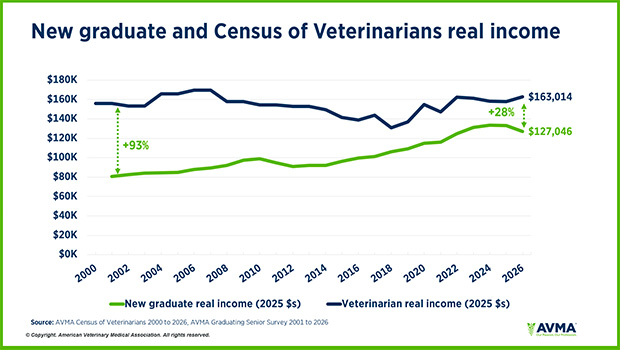
Average real income—or the amount adjusted for inflation—decreased year-over-year for new veterinary graduates, while it climbed for the overall population of veterinarians, expanding the compensation gap between these groups from 19% in 2025 to 28% in 2026. At the same time, the average veterinary student debt burden has risen and the number of recent graduates not receiving offers for employment or advanced education also has ticked up slightly.
Dr. Chris Doherty, assistant director for strategic business research and outreach in the AVMA Veterinary Economics Division, provided a comprehensive overview of the current veterinary workforce and the upcoming generation of veterinary professionals during a presentation at the 2026 AVMA Veterinary Business and Economic Forum, held virtually October 7-8.
His talk, “The Veterinary Workforce: Data-Driven Insights into the Veterinarian Population,” previewed the results of the 2027 AVMA Report on the Economic State of the Veterinary Profession, which will be available in the first quarter of 2027.
New veterinary graduates
The average compensation for recent veterinary graduates securing full-time employment was $131,784. However, once adjusted for inflation, the average real anticipated income (in 2025 dollars) for 2026 graduates was $127,046.
The data was collected from the 2026 AVMA Senior Survey, which was sent to final-year students at all U.S. veterinary colleges and two Caribbean veterinary colleges approximately four weeks before graduation.
Just about 6 out of 10 (58.0%) of new veterinarians this year secured full-time employment at the time of the survey before graduation; another 28.2% accepted offers in advanced education, including internships, residencies, and graduate studies; and 7.4% had not received an offer at that time.
Full-time employment has been declining for the past four years among recent veterinary graduates as advanced education remains steady and the number of those with no offers has increased from 2.1% in 2022. These figures do not include those who received an offer but hadn’t accepted yet or had accepted part-time employment.
Dr. Doherty also pointed out that while the number of new graduates with no offers was slightly higher in recent years, the rate is still very low compared to levels during and after the Great Recession, reaching almost 40% in 2012.
The survey also examined the areas of practice new veterinary graduates pursued and how starting compensation varied across career paths. Graduates entering full-time private practice had the highest average starting compensation at $133,056, compared with $101,234 for those entering public practice. Average compensation was lower for graduates pursuing advanced education, at $59,436 for internships and $54,988 for residencies. However, unlike in private or public practice, average compensation for internships increased from previous years.
For new veterinary graduates entering full-time employment, many also received a signing bonus (58.7%). Other forms of compensation included a moving allowance (34.6%), student loan repayment (19.9%), emergency case compensation (10.8%), and housing allowance (2.8%).
Overall, when considering veterinarians entering into private practice, as well as those entering advanced education, companion animal practice remains the most popular sector of the profession for new veterinarians, chosen by 71.5%. Less common choices were mixed animal practice (10.1%), equine practice (7.5%), and food animal practice (4.1%).
Student debt on the rise
Veterinary student debt declined during the COVID-19 pandemic years, between 2020 and 2023. Since then, student debt has been climbing, reaching a new high in 2026.

The average debt from earning a veterinary degree was $185,424 for all 2026 graduates, including those with no veterinary student debt, and $227,588 for those with veterinary student debt. Overall, 18.5% of all new graduates had no debt from veterinary college.
On the other end of the spectrum, 43.3% of new graduates owed $200,000 or more in veterinary student loans and 7.9% reported owing $400,000 or more. These figures account for student debt incurred during veterinary college only.
The average debt-to-income ratio (DIR) for new veterinarians entering full-time employment in 2026 was 1.5:1, indicating a debt that was 1.5 times the amount they were expecting to earn. This figure has also increased from previous years, and now 18.1% of new graduates have a DIR of 2.5:1 or greater.
Veterinarian income and demographics
Meanwhile, among all veterinarians, the average professional income reported in 2026 for 2025 was $163,014, according to data from the 2026 Census of Veterinarians.
“What we saw in the most recent data was a small increase in real income, but from 2022 onwards, it has been relatively flat or trended downwards even as nominal income increased,” Dr. Doherty said.
Benefits are another important part of how veterinarians are compensated, he said. The most common ones offered, according to census respondents, are continuing education expenses (80.0%), licenses (79.2%), paid vacation leave (74.6%), and association dues (71.4%).
A new question on this year’s census asked veterinarians what one benefit they most wanted to have that they don’t have currently. The top answer was educational loan repayment.
Dr. Doherty encouraged practice owners to analyze what factors make their practice an attractive place to work for veterinary team members and what factors could be improved upon. Further, he encouraged leaders to develop a retention plan that includes regular check-ins, performance reviews, and discussions on workplace satisfaction.
For more practical advice from the “The Veterinary Workforce: Data-Driven Insights into the Veterinarian Population” session at the 2026 AVMA Veterinary Business and Economic Forum, download the 3-2-1 Insight-to-Action Guide on the topic.
In addition, AVMA’s My Veterinary Life website offers an online library that helps veterinary students and recent graduates navigate their transition into the workforce, establish strong financial habits, and nurture personal wellbeing.
Fonte: https://www.avma.org/


