An AVMA task force is researching the benefits of an academic career amid a shortage of veterinary faculty
By Ashley Mayrianne Champagne and Malinda Larkin
A growing number of aspiring veterinarians are matriculating, but the number of veterinary educators to teach them has not increased at the same rate.
Over 16,600 students were enrolled in one of the 32 AVMA Council on Education (AVMA COE) –accredited U.S. veterinary colleges for the 2025-26 academic year, according to the American Association of Veterinary Medicine Colleges’ (AAVMC’s) most recent annual report. The number of first-year seats has increased, on average, 2.7 percentage points annually over the past decade, or 25 percentage points, going from 3,277 in 2016 to 4,390 in 2026 overall.
Meanwhile, the number of veterinary faculty during that time increased by 8.85 percentage points, from 4,171 in 2015 to 4,576 in 2026. Of those positions, 46.1% were tenured faculty, 36.8% were nontenured clinical faculty, and 12.9% were non-tenured research faculty, according to AAVMC data. The remainder were administrators.
Dr. Michael Lairmore, a former president of the AAVMC, said “It’s a general concern that’s been around for a while, but has been more acute in the last several years, in part because of the changing dynamics across multiple issues. Some are based on the number of new schools that are proposed and opening. They are in different stages of AVMA COE accreditation. There are also economic factors, such as discrepancies of salaries and compensation that veterinary colleges face in recruiting, especially in critical areas where there are shortages. Some specialties don’t have enough to meet public needs, let alone veterinary colleges.”
Root causes
There were 474 vacant, fully funded positions across veterinary schools in 2024, up from 403 positions in 2022, according to Dr. Emma Read, the AAVMC’s chief executive officer.
“The money is there to hire the faculty, but there are minimal numbers of faculty to be hired,” she said.
The rising opportunities available to veterinary specialists to enter private practice has made academia less attractive, she said. While staffing has always been a challenge, particularly in specialty areas, faculty departures during the COVID-19 pandemic exacerbated the problem.
“In the past, specialists could mostly only work in veterinary [teaching] hospitals. But now there is the option to go into private practice and work on a similar case load with more regular hours, so they move outside academia,” she said.
In contrast, those in academia often face a higher clinical case load, in addition to committee duties, service work, supervising residents and interns, research, and teaching students. All those things add to the job and can require more than a four-day work week, she said.
The shortage of specialists has become more evident as more specialty private practices open, existing schools expand their class sizes, and new schools of veterinary medicine are established, she said.
AVMA and AAVMC efforts
The AVMA Veterinary Specialty Organizations Committee (VSOC) assembled a task force in 2024 to investigate the reasons for the gap between faculty supply and demand as well as propose solutions.
Since its establishment, the task force has held an in-person meeting and conducted surveys across veterinary students, recent graduates, interns, residents, AAVMC institutions, veterinary specialty colleges, recently inducted diplomates, and other stakeholders to identify factors that might influence pursuit of careers in academia. Task force members are additionally examining considerations influencing faculty recruitment and retention in any given specialty, said Dr. Jim Weisman, AVMA’s chief professional engagement and academic affairs officer.
“The key focus has been on understanding the needs of veterinary specialists, as most veterinary schools are built on a model of having specialists as professors, and they also tend to do more clinical research. The gaps tend to be greatest in areas such as radiology, surgery, and cardiology,” Dr. Weisman said.
Dr. Lairmore, chair of the task force and former dean at the University of California-Davis School of Veterinary Medicine, explained that there are fewer veterinary specialists in general, likely due to the cost and length of advanced training programs, especially for those who are already entering veterinary practice with substantial student debt.
To become a specialist, veterinarians usually must complete an internship and three-year residency before passing a specialty board’s examination, but not all applicants may be placed into an internship or residency program in the first place.
Among 3,054 total applicants for 2,146 positions through the Veterinary Internship and Residency Matching Program in 2026, only 48% of applicants were matched to an internship or residency. However, some specialty areas, like food animal surgery and nephrology-urology, received fewer than five applications.
“Some specialties don’t have enough to meet public needs, let alone veterinary colleges,” he said.
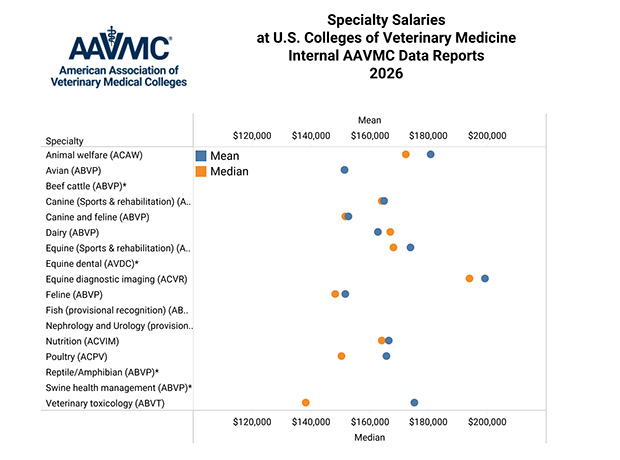
Even higher compensation may not be enough incentive for critical areas with shortages like anesthesia, behavior, nutrition, radiology, and surgery, he said. The average salary for veterinarians in 2025 at colleges and universities was $160,000, according to data from the 2026 AVMA Census of Veterinarians. This amount nearly matches the average professional income reported in 2026 for 2025, which was $163,014. However, veterinary specialists can often make substantially more money in private practice. For example, listings for a small animal surgeon in the AVMA Veterinary Career Center offered salaries in the range of $250,000 to $350,000.
In addition to economic factors such as salary and benefits, geographic limitations, requirements for advanced specialty training, and perceptions of work life-balance may play a role, Dr. Michael Lairmore wrote in a 2024 JAVMA article.
The task force is examining other ways schools are making roles in academia stand out, especially to the next generation. According to Dr. Weisman, the task force plans to release its findings in 2027.
Marketing academia
Veterinary colleges are placing greater emphasis on highlighting the full value they offer to prospective faculty. “Academia has a lot to offer, but we don’t always do a good enough job of communicating the full value of the recruitment package,” said Dr. Alicia Oliver, associate dean at Mississippi State University (MSU) College of Veterinary Medicine.
At MSU, that full value extends well beyond salary. Faculty have traditional benefits such as health insurance, retirement, and vacation, as well as access to temporary faculty housing for up to 18 months to allow time to find the right housing fit. Another significant and underappreciated benefit is tuition remission in which not only are faculty eligible for tuition remission, but eligible dependent children receive 50% tuition remission toward a bachelor’s degree at MSU.

“If you have two parents employed at the university, then eligible dependents get 100% off tuition,” Dr. Oliver said. “That’s a big attraction for prospective hires.”
MSU also allows faculty two paid consulting days a month, offering them the ability to expand their professional network and earn additional income. Other veterinary schools have created similar programs by which faculty can participate in consulting or private practice while earning an annual salary.
Those interested in conducting clinical trials and publishing research can also benefit from grant opportunities and other support educational institutions offer, Dr. Weisman said.
Innovative strategies
The AVMA task force is additionally investigating innovative ways veterinary colleges are educating students despite the limited number of faculty. Approaches such as faculty sharing, public-private partnerships, or use of virtual teaching methods could help alleviate issues with shortages, Dr. Lairmore said.
For example, at UC-Davis, where Dr. Lairmore was the veterinary school’s dean from 2011-21, a variety of specialists taught blocks of courses at other veterinary schools while remaining on faculty at UC-Davis.
“Could that be more organized? Could we have a national matching program among veterinary colleges for their needs?” Dr. Lairmore asked.
Already some veterinary colleges with distribute clinical education models have formed a group to share ideas and best practices. The Consortium of Workplace Based Education and Learning’s (COWBEL’s) vision is “to educate the veterinary community regarding the benefits of using a workplace based or distributed model of education to prepare new veterinary graduates. But Dr. Lairmore says more could come from this collaboration.
“Maybe there could be arranging agreements where instead of each one competing for a private practice to send students to, it could be better shared in large hospitals where faculty are already trained as educators, but multiple distributive models could rotate their students through that facility,” he said.

He also mentioned the possibility of leveraging professors from other disciplines, such as biology and anatomy, to teach lower-level courses, or recruiting from outside the typical intern and resident pipeline.
“We need people in the field,” he said. “Some folks I recruited at UC-Davis were from emergency practices where they had established themselves for 10 to 20 years but wanted to come back to be educator. They enjoy teaching and contact with students.”
The value of educating
Dr. Stephanie Inoue is one of those veterinarians who moved into academia later in their career.
She spent eight years in small animal practice before taking a daytime teaching position at Purdue University College of Veterinary Medicine. Sixteen years later, she now serves as Purdue’s veterinary skills and competencies director while continuing to teach clinical skills as part of the school’s problem-based learning curriculum.
Dr. Inoue said she enjoys the variety that academia offers as well as the opportunity to improve courses and develop new teaching approaches. More than anything, however, she enjoys developing the next generation into confident, capable veterinarians.
“While I enjoyed clinical practice, I found that helping students develop their skills, confidence, and clinical reasoning was particularly challenging and rewarding,” she said.
“Academia also gave me the opportunity to have a broader impact by helping train future veterinarians. I no longer practice clinically, but my years in general practice and emergency medicine continue to shape the way I teach.”
Fonte: https://www.avma.org/